Shetland Pilgrimage
Holy islands in Northern Scotland
Ice Cold in Trondheim
In 2030 we will be celebrating the millenium of the death of St Olav. In this blog, Neil Work reflects on a pilgrimage he made from Shetland to the shrine of St Olaf in Trondheim ten years ago.
Norway is heartbreakingly beautiful. It is also eye wateringly expensive. For the last 25 years these facts have shaped my summer holidays, nearly every year I have gone hiking in her mountains, sometimes with a long suffering companion, and camped to make the cost bearable.
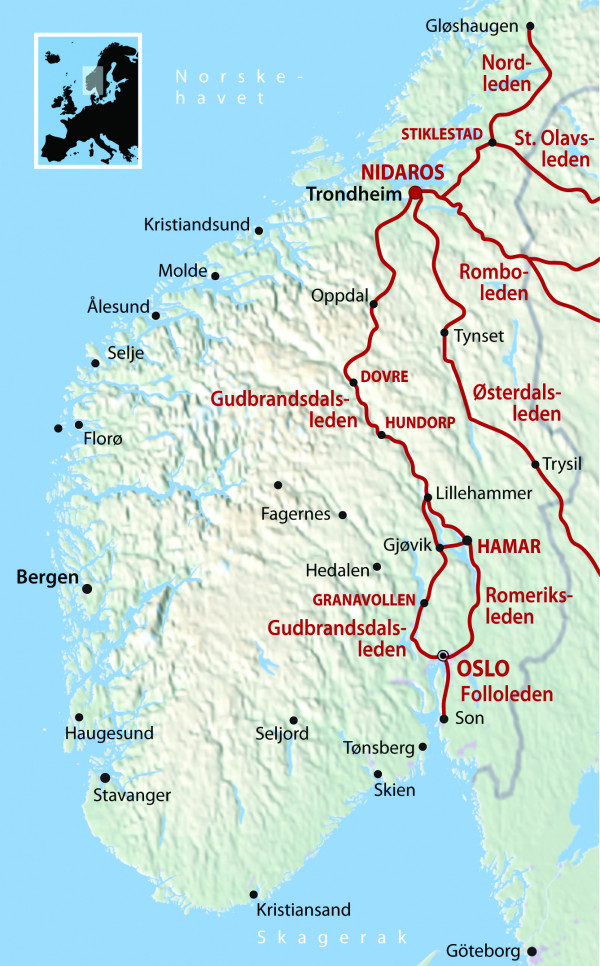
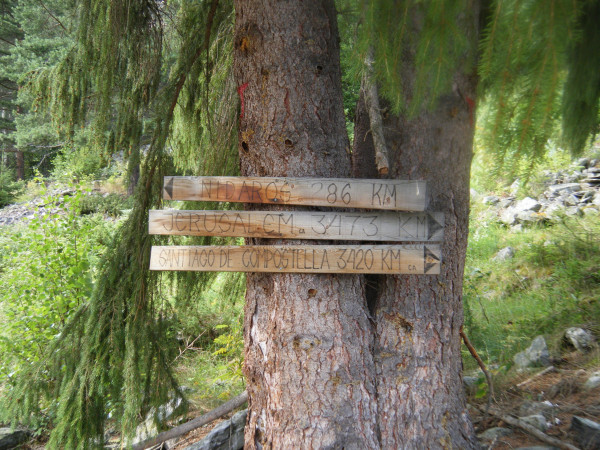
You can think of it as Northern Europe's camino (that pilgrim route in Spain). In the heyday of pilgrimages it is said that the chief pilgrim routes resembled a cross. They went south to Rome, east to Jerusalem, West to Santiago and, yes, north to Trondheim, to Nidaros Cathedral. The trails and paths led the devout from present day Scandinavia, Germany, Baltic States, Poland, Russia, etc. to the shrine of most holy St Olav, Eternal King of Norway.
The life of Olav Haraldsson, it is safe to say, really challenges the usual image we have of a saint. Born a true Viking in Ringerike about 995, these days we would label him in his early years as a child soldier, terrorist, war criminal and mercenary, as he raided Britain. Then he was invited to stay in Rouen with the Christian Duke of Normandy, converted, and he became inspired by the tales he heard of Charlemagne imposing Christian law under one crown. He also had prophetic dreams.
Returning to Norway, step by step he spread his rule over petty kings and chiefs, and enforced Christian law. He used force, although the teaching of the Church, even then, was against forcible conversion. In his defence the writer Sigrid Undset said he knew from within how evil some pagan practices were and would have considered them satanic, needing force to stamp them out. For example, the exposure of unwanted children. He united the country, but made enemies. They deposed him in 1028. He fled abroad (with his concubine! Perhaps he was a work in progress, like most of us). Returning two years later to reclaim his crown he was killed at Stiklestad, near Nidaros, in 1030. He appears to have expected to lose (from a dream), he was outnumbered but made a victory even less certain by only letting the hapless Christians in his small army fight for him. After the battle there was a solar eclipse.
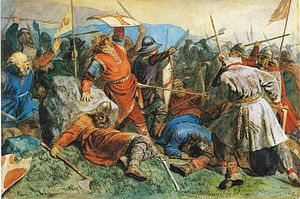
But it was by his death that a united Christian Norway was created. His enemies came to regret killing him, even the man who dealt the fatal spear thrust. The common people started to pray for his help, and found healing. Bishop Grimkel, originally from Britain, declared his sanctity. His body was found to be incorrupt. His cult spread across northern Europe and scores of churches honoured him. There is a 12th century Chapel in Shetland, in Unst, dedicated to him. Likewise a church in London. The great St Olav's in Tallinn, Estonia, was once thought to be the world's tallest building. And by the way, our church, St Margaret's in Lerwick, is on St Olaf Street, so there!
Pilgrims started to come to his tomb, eventually in their thousands. A vast network of routes branched out from what became a stately cathedral. For centuries they came. In the novel "Kristin Lavransdatter" the contrite heroine trudges there over the mountains to leave her dishonoured bridal wreath at his shrine. The kings of Norway were always crowned there.
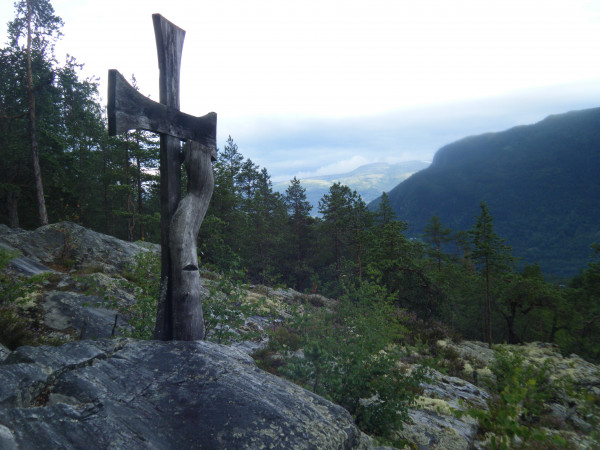
Then came the Reformation. As his attitudes hardened, Luther came to despise pilgrimages. The Protestant King Christian of Denmark, who ruled Norway by then, banned pilgrimages in 1603, under pain of death.
But truth will out. There is something in the human soul that has to be to express itself by pilgrimage. The Lutheran Church today recognises this. Why, there is now even a pilgrim trail in Germany that honours Martin Luther! And, since 1997, the Lutheran Church in Norway, along with generous government help, has encouraged pilgrims to come to his cathedral again. Olav's body was hidden at the Reformation, but his remains are probably still in the cathedral precinct, somewhere. The present high altar is where his shrine used to be.
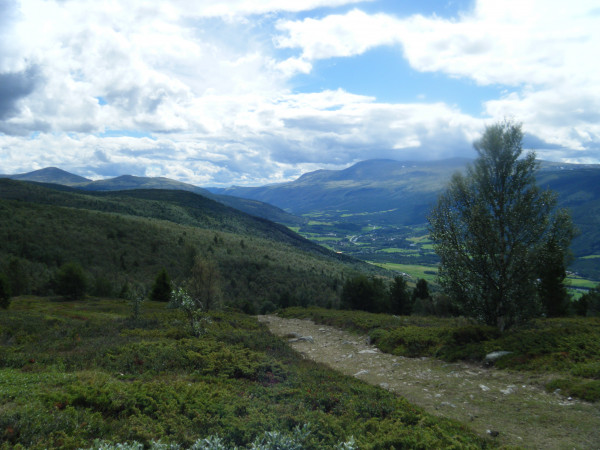
The main pilgrim path, well marked with distinctive posts and markers stretches over 600 km from Oslo. Geographically it follows the long ribbon like lakes north of Oslo, up the beautiful Gudbransdal valley, up and across the wild Dovrefjell plateau, then down to the gentler valleys and woods north of Oppdal. It is, and I say this emphatically, by no means straight. In this day and age how can it be, with all the properties, boundaries and roads it has to contend with. There is also a marked trail from Sweden and other possibilities, even by sea.
So how, in the Holy Year of 2016 was I going to honour the chain-mailed saint who brought Christianity to Shetland? It seemed logical to me to start at Lillihammer. After all, I would be coming straight across from Shetland. Going down to Oslo didn't seem right, plus, it would cost more, I would find it hard wild camping in the more built up area, it wasn't so scenic, and, I had discovered Sigrid Undset.
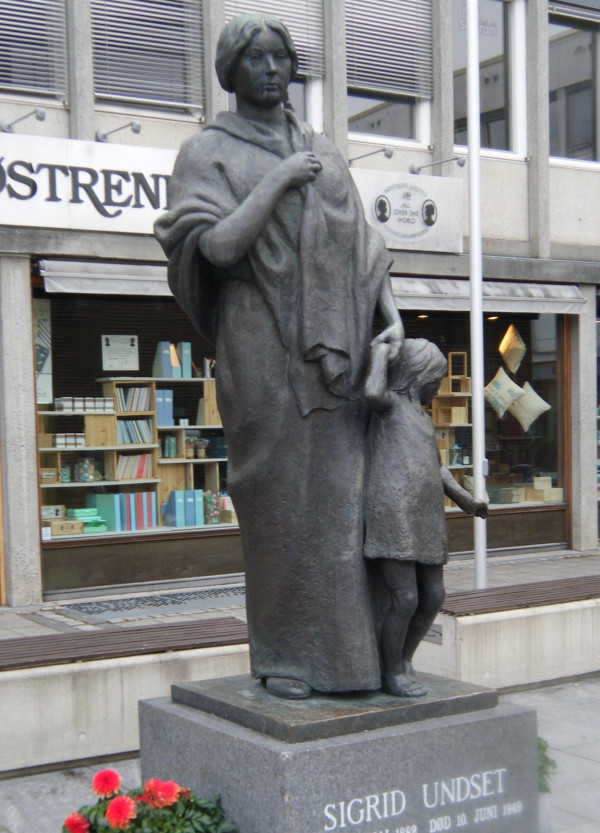
For years I had just known this name as that of an attractive young woman whose portrait appeared on the 500 Norwegian Kroner banknote (just enough for two days food). Then as I researched the pilgrimage, her name kept cropping up, and eventually I read about her astonishing life and achievements. Put briefly, she was the first female Nobel laureate in literature, expert on the sagas, Olav and the Middle Ages, a patriotic anti-Nazi and anti-Bolshevik activist, articulate Catholic convert and, in her opinion the most important, a good mother. Her home, now a museum, is in Lillehammer.
So I arrived there, armed spiritually with a pilgrim blessing for myself and accoutrements from Bishop Hugh, and feeling smug that I had got my pack weight, with food, down to 11.2 kg. The bright Italian curator, Irene, let me in early. There were Sigrid's awards from the King, family pictures, Nobel citation, her rosary and Bible under armoured glass, and much else. When others arrived we were taken on a tour of the house. Irene pointed out the bookshelf filled with books about St Catherine of Siena, which Sigrid had read to research her final book.
Then from that shrine to that up north just over 400 km were waiting to be hiked. If you are Norwegian or Swiss, or just well heeled, all you have to do is take a light day pack, your "skives" of bread, thermos and waterproofs and walk briskly from one establishment to the next. There are plenty of hotels, B&Bs, auberges, and hostels on the way. There is a compact Dutch guidebook which is very good at showing you where to stop, which is also in German and Norwegian. My English guidebook wasn't too bad, certainly better than no guidebook, but it seemed to attempt to Wainwright the route, explaining in exact detail which way to turn, etc, when the signposts on the route were usually quite clear about this. Most of the time I found it too stressful to follow. Then when the signs thinned out and I tried to find where I should be on the pages it was if I could hear her ticking me off for not paying attention to her.
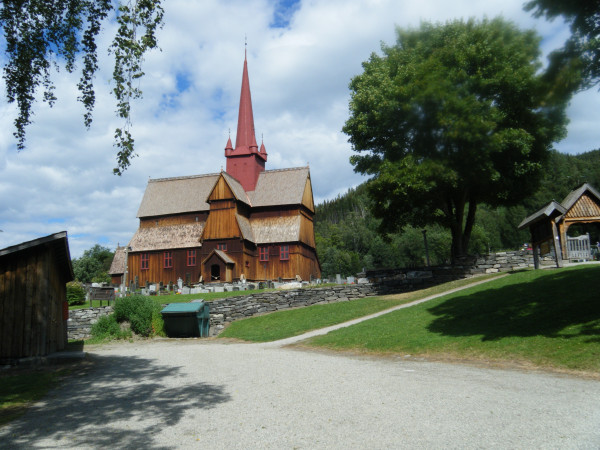
There were three other imaginary guides. I pictured these characters as the people who had cooperated to map out the Pilegrimsleden. One was a bookish rather earnest mediaeval re-enactor, dressed like a pilgrim complete with big staff and hat with scallop fixed to it. He wanted us, wherever possible, to follow the authentic pilgrim route that he had diligently rediscovered, even if it ran parallel to a quiet gravel road. Next there was the hearty very outdoorsy woman in shorts who loved to see views and pick bilberries. She had us going straight up from the valley floor to a wonderful viewpoint 600 m up, along a bit, then straight down again, because that is the only way you can do another 600 m climb a bit further on. Then there was the character I increasingly took a shine to, in his early thirties, dressed in sporty lycra like his pals who are all practicing skiing on rollskis, big wristwatch, curved mirror shades. He wanted to be on the tarmac facing the oncoming traffic, putting in the km/h. They each had their place. The route wouldn't work without them. But there was a point just south of Rennebu where I could have pushed the cheery woman off her viewpoint down to the empty road way down below!
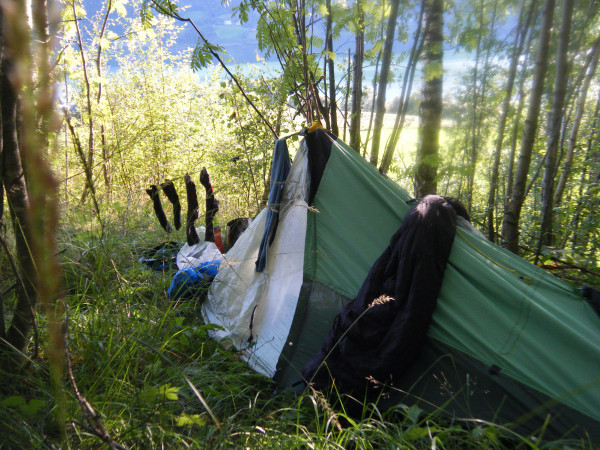
But it IS so beautiful, and full of variety, from the very beginning. A hot slog along tarmac would be followed by a deliciously cool tunnel of trees, and then you are walking along the edge of a waving field of barley. Every afternoon about four o'clock I would be searching my hopeless small scale map for a blue line. You have to have water to camp, but I always found something. Only once was it unfit to drink (but not to wash socks!). There was always a place I could legally pitch my poncho-tent. Following a sketchy map was fun, like pretending to be a downed pilot evading by means of a silk map of Europe. As for provisions, my guidebook helped, but I did find myself standing once in front of a huge supermarket, under numbers saying "23-7" trying to push the doors open on a Sunday. Luckily there was a petrol station. Norwegian petrol stations are brilliant. Always open. They stamped my pilgrim passport, provided feasts like hot baguettes and stocked my staple diet of spaghetti, cheese and "Bixit" chocolate biscuits. (Naturally, I always got comments from other hikers about British politics when they saw me with the latter!)
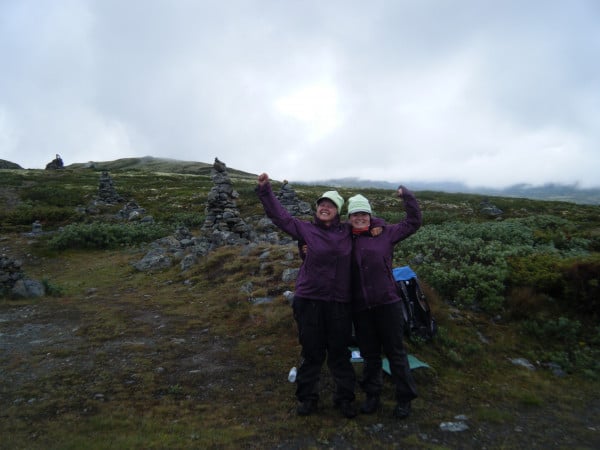
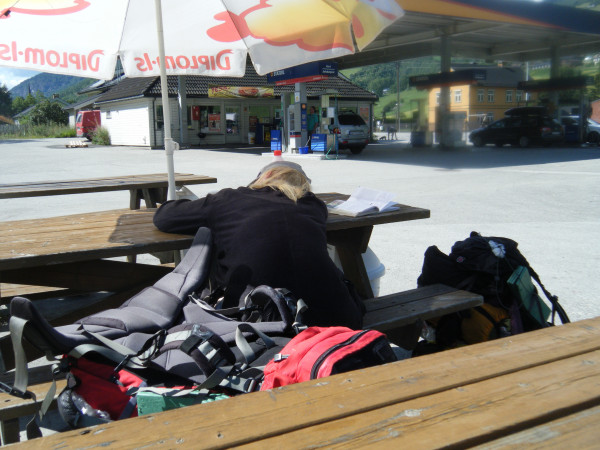
I started meeting fellow pilgrims after three days. There was a pattern; you would politely pass them, you would be having a break and they would pass you, then the next time you introduced yourselves. After a few days you were a community. I was very taken by one couple, ex-college pals Christina and Martina. I first saw Christina outside a petrol station, fast asleep on a seat. Seeing her backpack I thought, "That's too much for a girl to lug around". Two days later she was lifting up my pack, snorting "Eh! Far too heavy! You need to carry less!" "But it was 12 kg at the airport with three days food in it! OK I've got water, but..." "No!! This is 15, 16 kg!" "Give over..."
Yes, Pack weight snobbery is rife among long distance hikers.
Except for 'Johnny'. A tall German, his pack hit the roof beams of Olskastet hut as he jerked it onto his wide shoulders. Amongst other things strapped to his pack were an axe and three large onions. He didn't care, and went faster than anyone. Except 'the Spaniard'. I think 'the Spaniard' had been reading Ray Jardine, the American guru of ultralight hiking. He had a cuben fibre jacket, a small day pack, wore shorts in the rain and did 35 km a day in running shoes.
And then quite a few of us bumped into each other again in Trondheim. All a bit like a travelling "Brief Encounter".
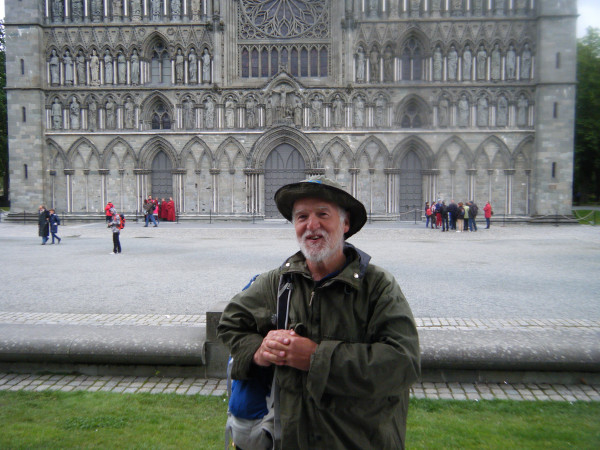
To be there at last in front of the elegant facade was quite moving. In pointless halting French I asked a chap clutching a "Norvege" guidebook to take my picture si play.
"Certainly. I press here, do I?"
In the picture I see how I should have blown my nose, and the paler statue of Olav among the other saints, smiling enigmatically.
"Ice Cold in Trondheim"? Well, I very much like the movie "Ice Cold in Alex" and in my research found out that a pilgrim who carries a special written request from a Bishop has to have that request carried out. I thought it would be nice to get an ice cold Carlsberg, or any-hugely-expensive-in-Norway beer, on arrival. Bishop Hugh was sympathetic enough to give me the necessary letter. Thinking quickly on their feet the welcomers at the Pilgrim Hostel apologised that the 'Pilgrim Bar' was closed for the season, but that I was welcome to as much coffee as I liked.
Which was actually pretty good!
Neil Work, 1 September 2026.
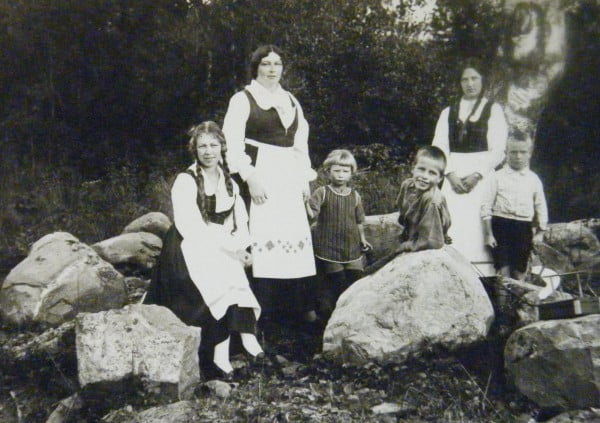
POSTSCRIPT. On 8th July 2026 the Bishop of Oslo started the process for Sigrid Undset to be declared a saint and her cause has been officially opened. She has been given the title Servant of God. Her novels have been recently republished in the USA in a new translation. The photo shows Sigrid Undsted with her family.
Other posts
Welcome
Welcome to shetlandpilgrimage.scot.

Links: Shetland Churches
- Catholic Church, Shetland.
- Episcopal Churches in Shetland.
- Methodist Churches in Shetland.
- Orthodox Community of St Ninian, Shetland.
- Shetland Church of Scotland.
Shetland
- Shetland Retreat, Fetlar.
- Papa Stour Community History Group.
- Hamars & Harps, Haroldswick, Unst.
- Wild Skies, Shetland.
- Fair Isle Bird Observatory.